

Bronze mirror handle
Archaeological museum Messenia, Kalamata
 M 32 1
Link copied


Bronze mirror handle
6th century BCE
Archaeological museum Messenia, Kalamata
Volimnos on Taygetus, Messenia
Length: 21 cm x Width: 8 cm

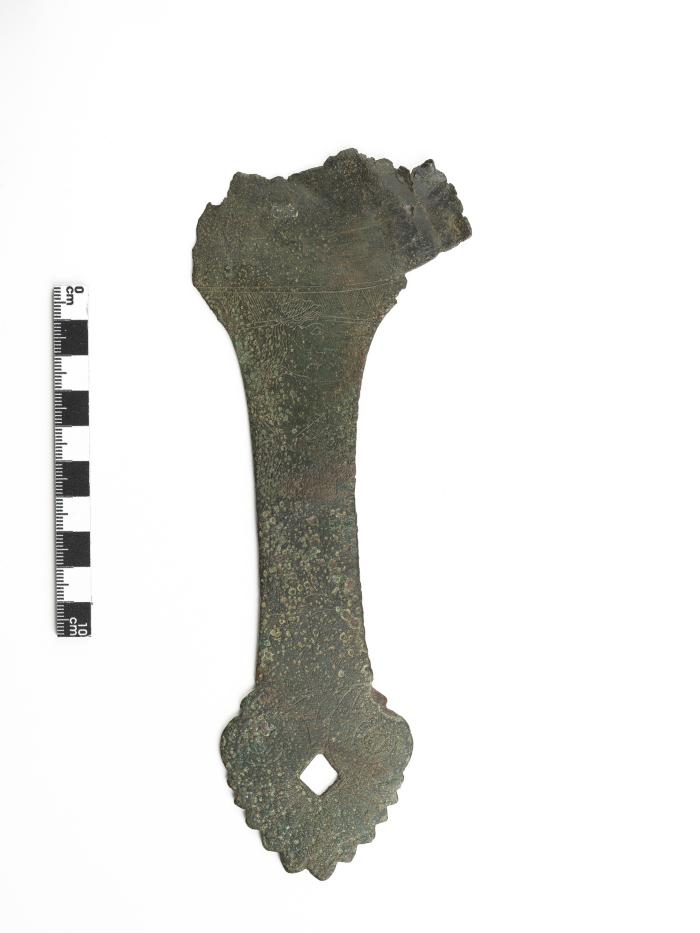
Handle of a bronze mirror. Preserved is a small part of the handle that was integrated with the disc. The tip of the handle shaped as an upturned 11-leaf palmette over volutes with a rhomboid hole at its core. The leaves and the volutes are formed with incisions. The stem of the handle is divided from the disc with a zone of seven incised hatched triangles. The handle front side is decorated with an incised female figure, which turns to the right, wearing a peplos and a diadem on her long wavy hair. The figure stands on a horizontal incised line, with an incised 8-leaf palmette below it. The handle dates to the archaic period (6th cent. BCE). It was handed in 1960 by a resident of Artemisia, on Messenian Taygetus. It was probably a votive offering to the sanctuary of Artemis Limnatis at Volimnos, near Nedousa. Bronze offerings from the area of Volimnos are exhibited in the Archaeological museum of Messenia. Located in Volimnos is the small church of Panagia Volimniotisa or Kapsochelovolousa, with ancient architectural members and inscriptions having been immured in its masonry. The finds attest that the sanctuary was in operation from the early geometric period (mid 8th cent. BCE) to the late antiquity (3rd/4th cent CE). The mirror, as a predominantly female symbol and as a votive offering to the sanctuary of Artemis, is associated with the goddess’s role as a protector of the transition of females from one age stage to another.