
Depas amphikypellon
Archaeological museum Messenia, Kalamata
 6660 2
Link copied


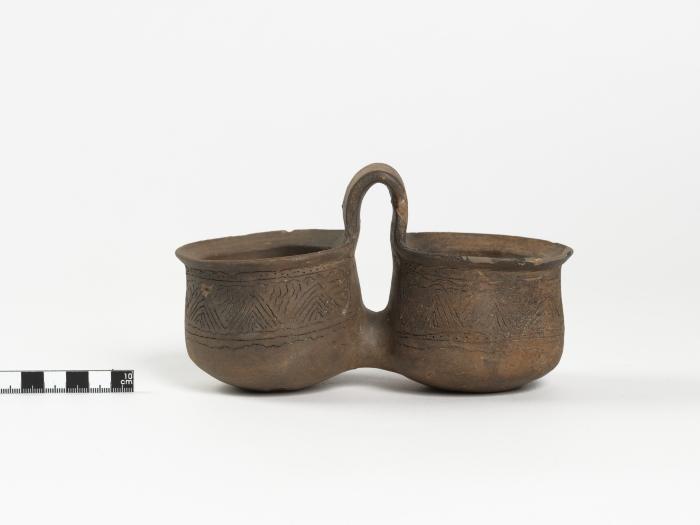
Depas amphikypellon
2000 CE – 1800 BCE
Archaeological museum Messenia, Kalamata
Middle Helladic tumulus 2, Kastroulia, Ampheia, Messenia
Height: 1.1 cm

Small-sized depas amphikypellon (two-handled drinking vessel) of minyan type, almost intact, made of grayish-brown clay with incised and punctated decoration. The artefact consists of two small vessels with a deep body and an out turned rim. The two vessels are connected via a very short, solid horizontal stem and an arched, raised vertical handle. Incised horizontal and wavy lines and small spots below the rim. Further down, a zone of alternating upward- and downward- facing triangles. The former are filled with stacked angles and the latter are hatched with oblique wavy lines. Below this zone the decoration is incised and linear. Found at a female burial in the Middle Helladic family tumulus 2 at Kastroulia, Ampheia, near the Ellinika ridge, with the acropolis of chamber tombs and the acropolis of classical Thouria. The female burial in tumulus 2 was accompanied by an assemblage of domestic, food and drink vessels. The two tumuli at Kastroulia indicate the existence of a hierarchically structured society in this part of Messenia, already in the Middle Helladic period. Minoan influences are notable in some of the vessels, which must have been artefacts of high status and value. The depas amphikypelon is one of the most characteristic shapes of the Middle Helladic period. It has been found in domestic, as well as in burial contexts and it is considered as a ritual vessel.