

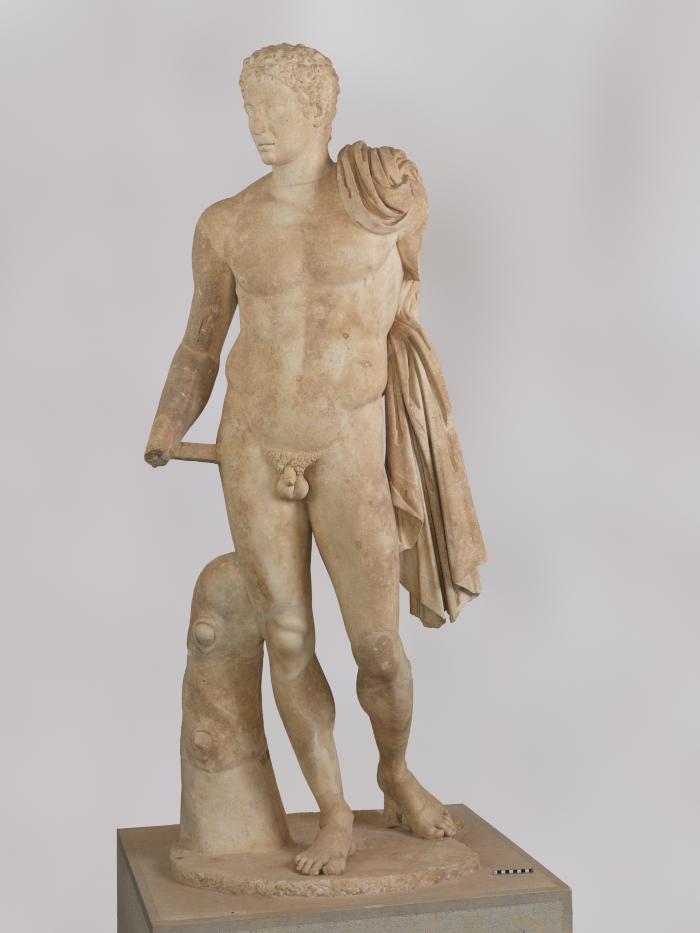
Statue of Hermes
Archaeological museum of ancient Messene
 8664 1
Link copied


Statue of Hermes
1st century
Archaeological museum of ancient Messene
Gymnasion of ancient Messene
Statue
MarbleHeight: 232 cm

Marble statue of Hermes. Found in the west stoa of the Gymnasion of ancient Messene, in room IX, fallen in front of its base. Based on epigraphic evidence it had been transported here from another location, were it stood originally. The gods' messenger, sponsor of commerce and of the exercising youths is depicted in divine nudity, larger than natural (2.32 m.), ready to stride. Its support, shaped as a tree trunk, was added by the copyist. A chlamys is thrown over his shoulder, folded around the bent left arm. He was probably holding the kerykeion (or caduceus) in his right hand. His upturned left palm touches his hip. This is a high quality 1st cent. CE copy of a 4th cent. BCE statue type. It is recognized not as a work of the school of Praxiteles, but of the successors of Polycletus and, mainly of Skopas. Its is, indeed, iconographicaly very close to Hermes psychopomp on a relief Ionic column from the Artemision in Ephesus, were Skopas of Paros had worked. The worship of Hermes was very popular in the ancient world. His responsibility as a guide of the souls to the underworld is of particular importance (Hermes psychopomp or "soul guide"). His sanctuaries are usually in humble sites, located at gates, along roads or at borders. The Hermes of Messene is iconographicaly depicted as a psychopomp, a type known from a relief in the Artemision of Ephesos. The association of the statue with the underworld is corroborated by its proximity to the nearby burial monuments of the Gymnasion. It has been proposed the face of Messene's Hermes combines the idealistic elements of the god with the personal anatomical features of the deceased (nose shape, fleshy, half opened lips). This trait was very popular in the upper classes of the roman period and could be connected with the honorification of the heroised dead.