

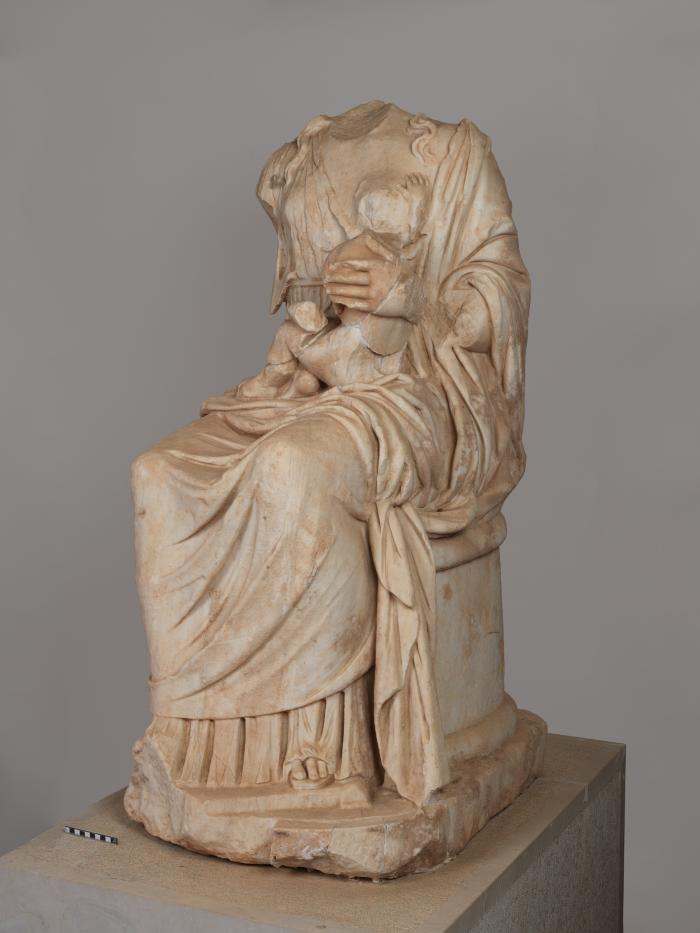
Statue of Isis nursing
Archaeological museum of ancient Messene
 13545 2
Link copied


Statue of Isis nursing
99 BCE – 99 CE
Archaeological museum of ancient Messene
Iseion, ancient Messene
Statue
MarbleWidth: 52 cm x Height: 1.135 cm

Statue of seated Isis holding a baby. Made of a single marble piece, including the plinth. The goddess sits on a secret cist, wearing a foot-long chiton, girded below the breasts in Heracles knot. She holds her son Oros or Arpokrates, touching his back tenderly with her left hand. The baby touches the goddess’s breast with his right hand, ready to be breastfed. She wears a lushly folded himation over the chiton, covering the right part of the torso and the thighs; two curls of hair fall on either side of the neck. Her feet, wearing sandals, stand sideways on the integrated low foot-rest and only her toes stick out from the folds of her chiton. This is a hellenized statue of the nursing Isis, a work of the early roman period. The prototype probably originates in Ptolemaic Alexandria of the 3rd cent. BCE. The different statuses of Isis are attested in Messene, where another statue, in the type of Pelagia, was found. Pausanias mentions the sanctuary of Sarapis and Isis next to the theatre of Messene. It is here that a large underground, vaulted, Π-shaped stoa was found, which comprised cisterns related with rituals of initiation to the worship of this egyptian deity. After the abandonment of the sanctuary, the cistern was used as disposal site for building material in the 4th and 5th cent. CE. Among the refuse were found numerous fragments of marble sculpture, including the statue of the nursing Isis. Isis, in her many capacities, was succeeded by Theotokos (Virgin Mary).